Airbrushes & Airplanes
 Lesson 2 Debrief — Navigating the Unknown
Date: November 6, 2025
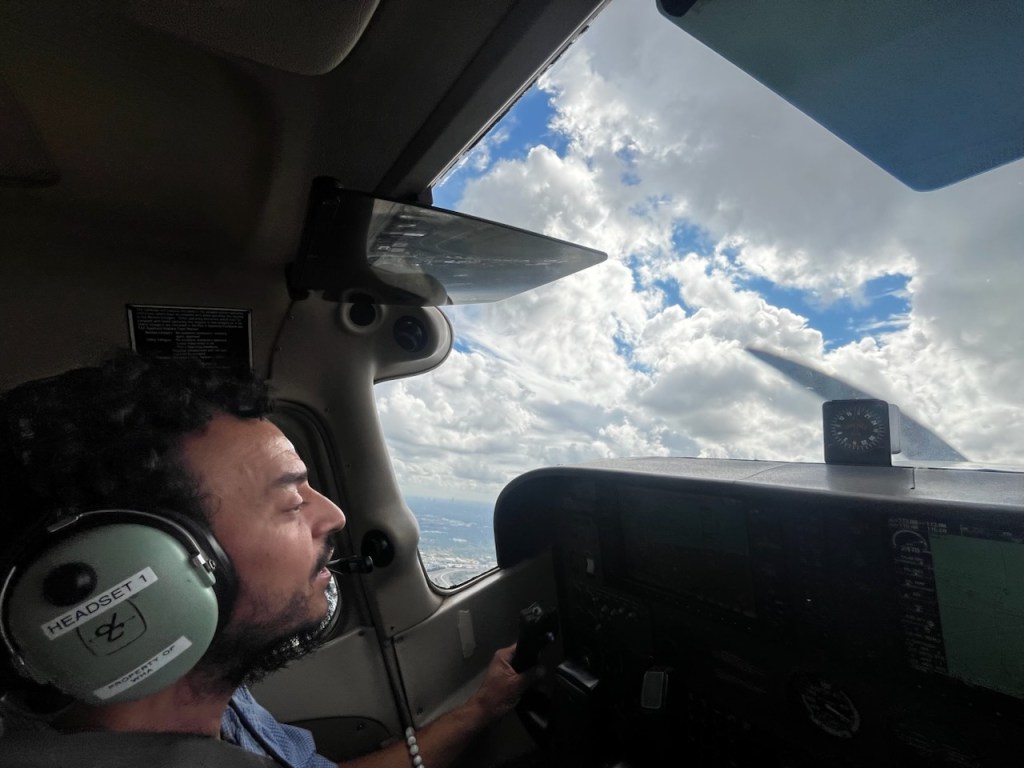
Recently in October of this year 2025, I did my Discovery Flight. After all the chatter, blogging about it, calling this blog and journey Airbrushes & Airplanes; it was about time I took my first flight. I do not think it was ever taking that first flight that I worried about. It was the thought that the first flight would signal my flight training. And it did! I have no knowledge or experience in receiving sponsorship, however, that was a target I had hoped for before jumping in. But now that it is done, I would like to keep going almost at all costs. Luckily, they offer lessons in one or two hour increments.
As of the moment I am typing, the day I took my next lesson, first flight lesson and completing my first full hour of flight altogether was yesterday, the 5th day of November. That is when I began my written journal entry. And earlier today I continued the entry with what I am posting here.
The 6th of November 2025,
I think back to my Discovery Flight — it wasn’t until the second turn that I realized we were flying in circles, landing and taking off repeatedly.
For today’s flight, my instructor explained that we were practicing turns, stalls, and basic maneuvering.
At the time when we were in the air, I gave little consideration to where we were or where we were going. When we began heading back home, I was completely lost. Even when my instructor pointed out I-10 and downtown, I couldn’t interpret where we were.
Before taking off, we listened to the weather on COMM 2. That made me wonder — what directs us to use that specific frequency? I later learned it was the airport’s ATIS broadcast, the Automatic Terminal Information Service that provides critical details like wind direction, temperature, and barometric pressure for setting the altimeter.
That broadcast gave us the altimeter setting, which we entered into both the analog and digital displays. It ensures we’re flying at the correct altitude, accounting for real-time air pressure and density. If not matched properly, it can throw off airspeed and altitude accuracy — something I hadn’t realized before.
Later, my instructor asked about airspace. I admitted I wasn’t entirely sure, but I’ve been reviewing it since.
Class D is where student pilots like me can operate with two-way radio communication. Class B requires explicit clearance before entering, while Class C allows VFR entry with proper communication and a Mode-C transponder. Class A is reserved for IFR flights above 18,000 feet.
Understanding these layers is helping me visualize invisible boundaries in the sky — a kind of structured freedom that defines aviation.
Another curiosity came up about radio communication. Why do we repeat the airport name at both the start and end of each transmission? It turns out it’s not like saying “10-4” or “over.” Instead, it’s about clarity. Radio frequencies are often shared by several airports, so identifying the one you’re referring to prevents confusion.
For example:
“_____ Airport traffic, Cessna 142 Bravo Sierra, 10 miles north, inbound for landing Runway xx, ____ Airport.”
It’s a rhythm of communication that ensures everyone listening knows exactly who you are and where you’re talking about.
Right now, navigation still feels challenging. My internal compass doesn’t quite align yet when looking down at maps or displays. Highways and landmarks I know from the ground lose meaning from above. I’m learning that orientation takes time — and that sometimes it’s best to look outside the window and reconnect with the world below before diving into the nav system.
Every lesson adds another layer of awareness. I’m beginning to see how each question leads to something deeper — how understanding systems, communication, and procedure brings a new kind of calm to the cockpit.
I review each flight with my eyes closed, reliving the moments, the questions, and the things I need to ask next time. The process itself feels like a journey — not just through the air, but through understanding how to navigate both the aircraft and myself.
—End of journal entry
I would have to say that my favorite subject that I have studied is Aviation. In doing so, I did have to learn about physics, mechanics, flying principles, weather patterns, and navigation. There is still much more I need to learn. I am excited to have my first hour of flying and 19 more needed to do with an instructor.
It is a journey worth experiencing and documenting. Thank you for reading. Hope to keep you updated soon. Don’t forget to check out the music
Fly High Luna Sky and other songs at https://audius.co/alexairbrushluna, and/or get the token
#AlexAirbrushLuna
 PEARLS EMPIRE
Leave a comment